

Introduction
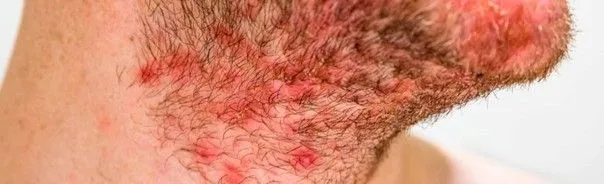
Tinea barbae, or ringworm of the beard, is a deep fungal infection affecting the hair follicles of the beard and moustache. It is caused by dermatophytes, most often of animal origin (zoophilic, i.e. transmitted by animals). The condition affects adult men almost exclusively and requires prompt medical treatment to prevent inflammatory and scarring forms.
Symptoms
- Inflamed patches in the beard area
- Follicular papules and pustules
- Possible painful nodules
- Localised hair loss
- Crusting and oozing
- Local swelling
- Tender to the touch (inflammatory forms)
- Possible swollen regional lymph nodes
Causes
- Infection with dermatophytes (often Trichophyton verrucosum, T. mentagrophytes)
- Transmission
- Contact with animals (cattle, cats, dogs) Indirect contact via contaminated objects
- Contact with animals (cattle, cats, dogs)
- Indirect contact via contaminated objects
- Minor injuries from shaving
- Predisposing conditions
- Farm work Weakened immune system
- Farm work
- Weakened immune system
Diagnosis
- Suggestive clinical picture
- Mycological testing is essential: Hair sampling Direct microscopy and culture
- Hair sampling
- Direct microscopy and culture
- Differential diagnosis with: Bacterial sycosis Bacterial folliculitis Inflammatory acne
- Bacterial sycosis
- Bacterial folliculitis
- Inflammatory acne
Treatments
- Oral antifungals (terbinafine, itraconazole depending on the organism)
- Duration
- several weeks depending on severity
- Topical antifungals as an adjunct
- Gentle antiseptic care
- Temporarily stopping shaving
- Disinfection of shaving equipment
- Identifying and treating the animal source
- No instrument-based technology
- Specialist dermatological care
- systemic treatment is mandatory
Management
Dermatological care is essential
Clinical and mycological follow-up
Prevention of scarring complications
Patient education on sources of infection