

Introduction
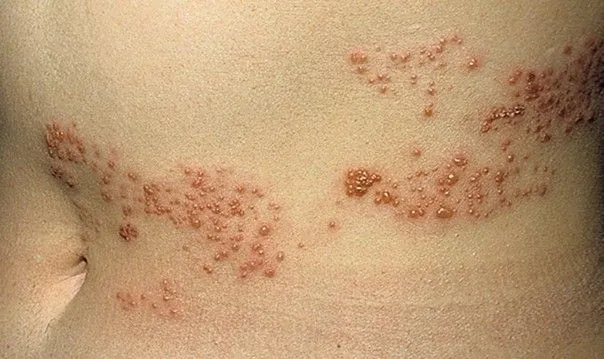
Shingles appears as a painful rash that follows the path of a nerve.
Symptoms
- Localised pain, burning or electric-shock sensations
- Skin hypersensitivity before the rash appears
- One-sided blistering rash in a band, following a dermatome
- Redness followed by crusting
- Mild fever, fatigue
- Possible itching
- Persistent pain after healing (post-herpetic neuralgia)
- Possible eye involvement (ophthalmic shingles)
Causes
- Reactivation of the varicella-zoster virus
- Contributing factors
- Older age Severe stress Weakened immune system Chronic illness
- Older age
- Severe stress
- Weakened immune system
- Chronic illness
- Contagiousness
- Possible in people who are not immune (can transmit chickenpox).
Diagnosis
- Clinical diagnosis in most cases
- Typical appearance along one dermatome on one side
- Viral PCR possible if in doubt
- Urgent eye examination if ophthalmic shingles is suspected
- Differential diagnosis with: Herpes simplex Localised inflammatory skin conditions
- Herpes simplex
- Localised inflammatory skin conditions
Treatments
- Aciclovir
- Valaciclovir
- Famciclovir
- Painkillers
- Anti-inflammatories
- Specific treatments for nerve pain if needed
- Mild antiseptics
- Drying the lesions
- Avoiding scratching
- Photobiomodulation (low-level laser) for residual pain
- Specialist management of post-herpetic neuralgia