

Introduction
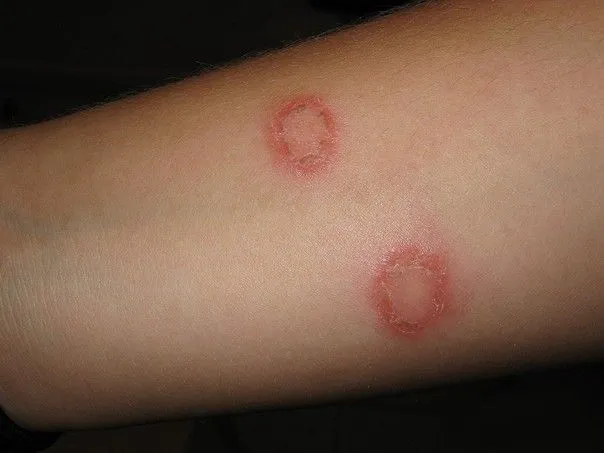
Ringworm of the body, or tinea corporis, is a superficial fungal infection of hairless skin caused by dermatophytes (most often Trichophyton or Microsporum). It is passed on through direct contact with an infected person or animal, or with contaminated objects. With appropriate antifungal treatment, it generally clears up well.
Symptoms
- Well-defined ring-shaped patches
- Red, slightly raised, scaly border
- Paler or apparently healthy centre
- Itching is common
- Gradual outward spread
- Single or multiple lesions
- May affect the trunk, limbs or face
- Worsening if topical corticosteroids are used inappropriately
Causes
- Infection with dermatophytes (Trichophyton, Microsporum, Epidermophyton)
- Transmission
- Skin-to-skin contact Contact with animals (cats, dogs) Contaminated objects (towels, clothing, mats)
- Skin-to-skin contact
- Contact with animals (cats, dogs)
- Contaminated objects (towels, clothing, mats)
- Contributing factors
- Moisture Sweating Close contact with others Weakened immune system
- Moisture
- Sweating
- Close contact with others
- Weakened immune system
Diagnosis
- Diagnosis is essentially clinical
- Suggestive ring-shaped appearance
- Mycological sample (direct microscopy + culture) in the case of: Diagnostic doubt Extensive forms Treatment failure
- Diagnostic doubt
- Extensive forms
- Treatment failure
- Differential diagnosis with: Nummular (discoid) eczema Psoriasis Pityriasis rosea
- Nummular (discoid) eczema
- Psoriasis
- Pityriasis rosea
Treatments
- Topical antifungals (azoles, allylamines)
- Applied once or twice a day for 2 to 4 weeks
- Oral antifungals in the case of
- Extensive lesions Multiple sites affected Resistance to topical treatment
- Extensive lesions
- Multiple sites affected
- Resistance to topical treatment
- Careful skin hygiene
- Drying the skin thoroughly
- Disinfection of linen and objects
- No specific device-based treatment
- Medical dermatological care
Management
Dermatological care tailored to the extent of the infection
Patient education on transmission
Treatment of contacts if necessary
Follow-up until complete clinical cure